On the planet Aramordar, as on the present-day Earth, a wide variety of languages existed. There are differing views on how to count language families, but including smaller families, the total comes to just under thirty. The total number of individual languages is estimated to have ranged between roughly 3,000 and 9,000 depending on the period.
Elhigyeth Manipulation Languages (EMLs)
Varokeřim and Old Varokeřim
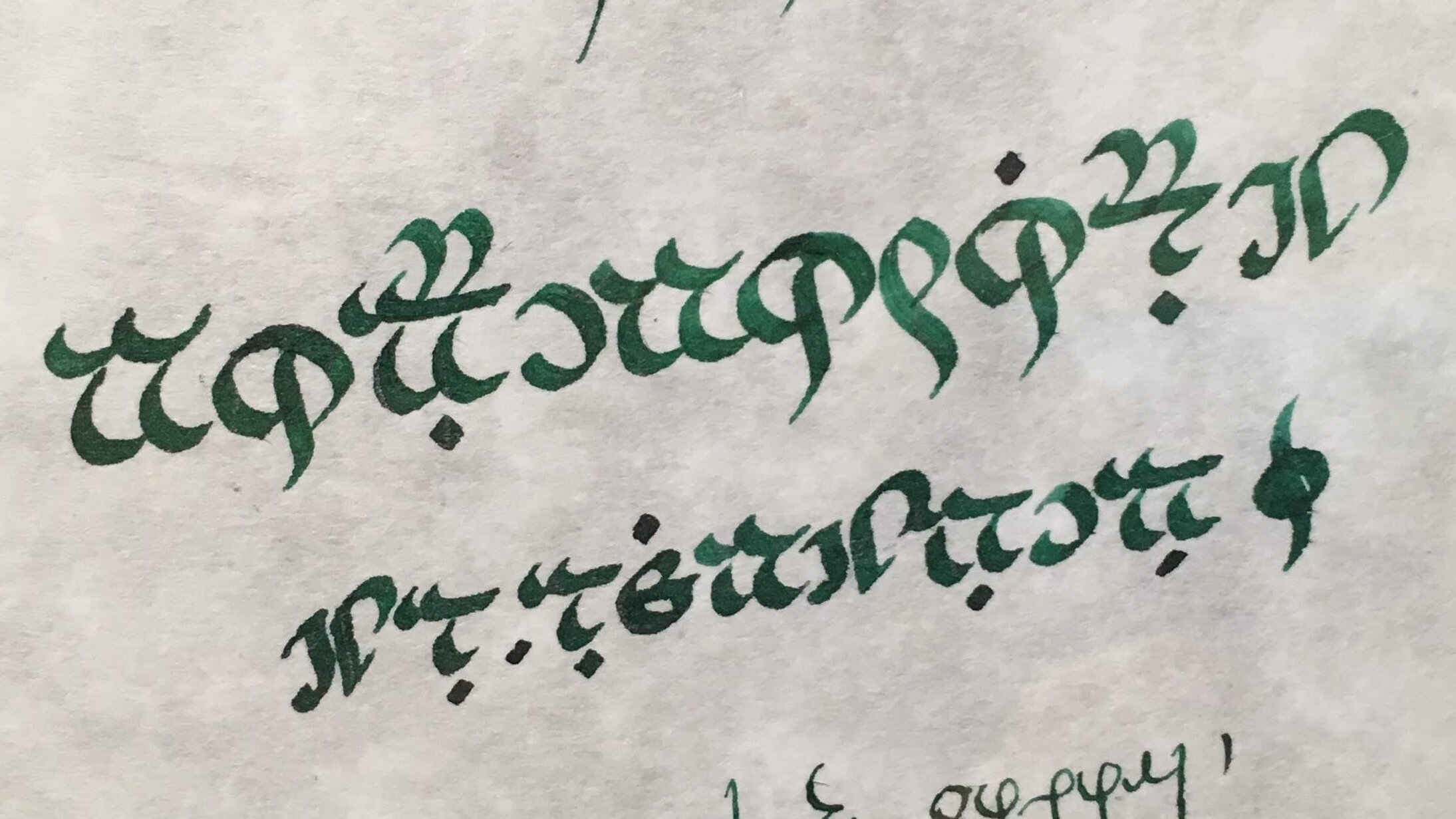
Varokeřim is an artificial language created by the Eight Heroes (the Sarna Afhita) in order to manipulate the eight Elhigyeth—the elemental forces that constitute Firraksnarre. According to tradition, the heroes secluded themselves in a temple for a full 360 days, during which they deliberated and collectively brought the language into being.
The original form of Varokeřim (Old Varokeřim, Varokeřim Vasdora) was designed with a highly complex grammatical system and made intentionally difficult to master, thereby preventing the language from being misused. However, as time passed, it came to be appropriated for malevolent practices known as sorcery, and the language itself became corrupted. In response, the sages of Wotūria—successors to the Eight Heroes—undertook a major reform of the language. The result was Varokeřim Enoma (New Varokeřim). In ordinary usage, when one refers to “Varokeřim,” it generally means Varokeřim Enoma.
Varokeřim has a relatively small phonemic inventory. Its consonants contrast for voicing, and its vowels contrast for length. Typologically, it exhibits a high degree of agglutination: parts of speech, nominal case, and verbal tense are expressed primarily through affixation. Nouns possess five cases, but there is no inflectional variation for gender or number.
Tiqhebic Languages
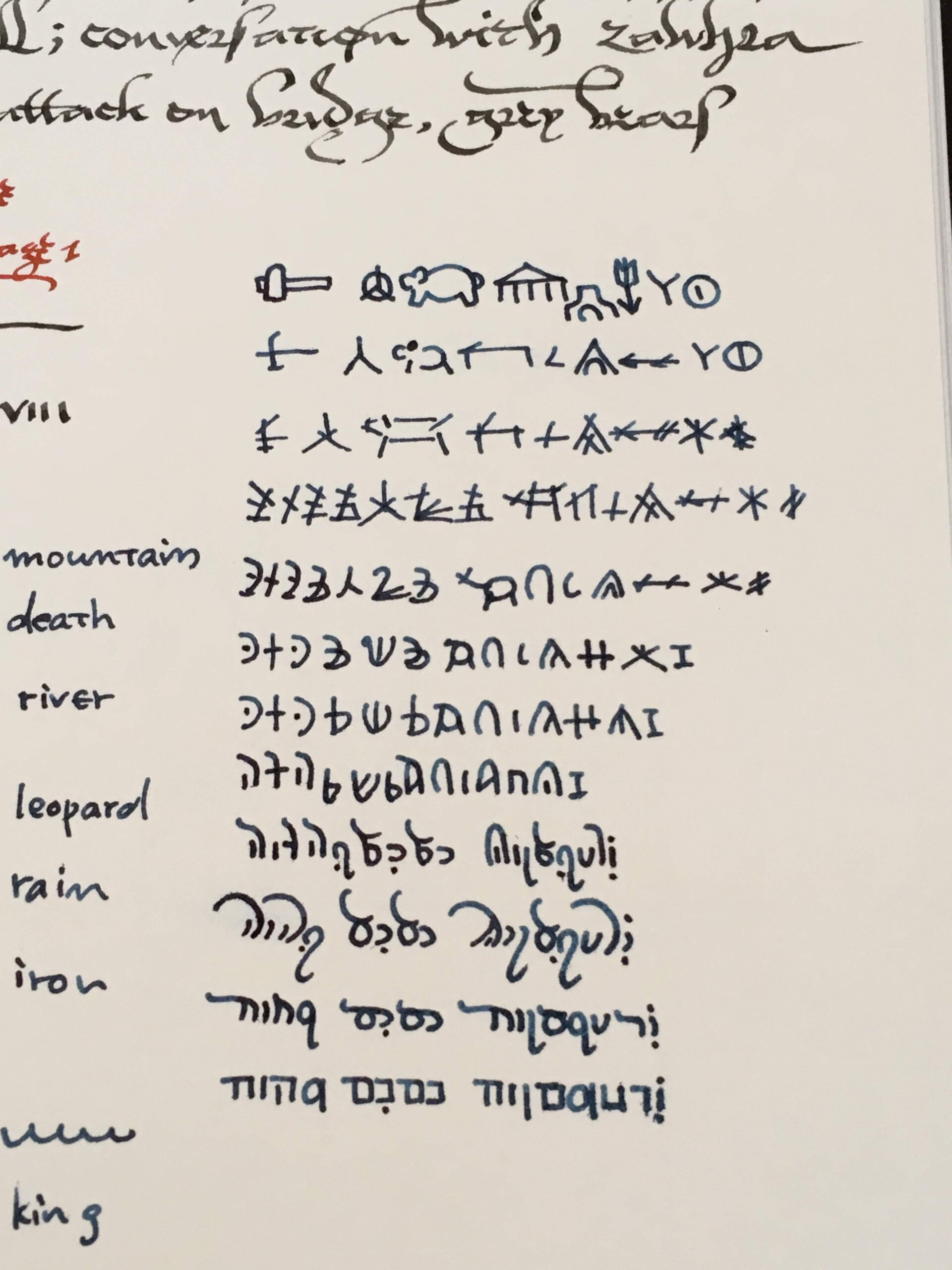
The Tiqhebic (Tiḥebic) languages (Othba’aran: Tiḥāḇrun-aḵtanāt) are a language family distributed mainly across the southern continent of Aver, as well as the southern tip of the Greater Western Continent. Although their geographic range is small, many mixed languages arose through contact with the Ethúlic and Aleyuan language families. Moreover, because Tiḥebic languages mutually borrowed vocabulary from surrounding languages and influenced one another grammatically, this relatively geographically compact family has nonetheless exerted considerable influence on the languages of Kerrenorde, Rhavorde, and Indrorde.
Most Tiḥebic languages exhibit VSO word order and are agglutinative or inflectional languages with either ergative or split-ergative alignment. Proto-Tiḥebic is thought to have been characterised by an absolutive–ergative case system together with a large number of oblique cases. In Western Ṣermeḵ, early contact with the languages of Aver and the Greater Western Continent led to a reduction of the case system at an early stage, and nearly all language groups shifted to a nominative–accusative system.
In contrast, in Eastern Ṣermeḵ the number of cases was preserved until a relatively later period. However, among the Reḵtarre languages, contact with the Ethúlic linguistic area was particularly intense, and some regions were even absorbed into the Artíjihàk linguistic sphere during the period of the Lórandàr Empire. As a result, these languages possess an overwhelmingly large number of vowels compared to other Tiḥebic languages. In To’on, weakening of plosives can be observed in certain environments. Furthermore, while the Reḵtarre languages, for the same reasons, shifted first to a split-ergative system and subsequently to a nominative–accusative system, the Rúnkeḥesian languages retained an ergative–absolutive system.
Tsermekh Languages
Ethúlic Languages
The Ethúlic Languages (Artíjihàk: Edníe Ethúlre, Late Artíjihàk: Ednē Ethúlle) constitute a language family distributed across the insular regions of the Eastern Archipelago (centered around Lórandàr), the northern coast of Aver, and parts of Rhavorde.
Averi-Ethúlic Branch
These are the Ethúlic languages found in eastern Aver. Together with the Andàric and Varic families, they form the larger Ethúlic language family. They were strongly influenced by the indigenous Tiḥebic languages, undergoing sound changes, lexical changes, and grammatical changes as a result. During the Amdorustan period and the Iron Age, many languages exhibited SVO word order, but later VSO order became predominant.
Varic Branch
A language family distributed across the northern part of the Eastern Archipelago, and one of the three principal branches of the Ethúlic family. These languages mutually influenced the Littoral Enseridarian languages, the Aleyuan languages, the Chatúan languages, and the related Andàric family. Many languages in this group are predominantly monosyllabic, and in certain subgroups such as the Cho-Suma languages, isolating characteristics are especially strong.
Andàric Branch
A language family widely distributed from the eastern coast of the Central Continent to the Eastern Archipelago, and one of the three principal branches of the Ethúlic family. Their homeland is thought to have been either the southeastern coast of the Central Continent or the northern coast of Ṣermeḵ, from which they migrated over long distances and dispersed widely. Among the Ethúlic languages, they experienced particularly intense contact with the Aleyuan family and incorporated many grammatical elements from Aleyuan languages. They preserved the old inflectional system of Proto-Ethúlic longer than the other branches, and many languages in this family possess infixes and circumfixes.
Other Language Families
Tsermekh Aboriginal Languages
The Tsermekh (Ṣermeḵ) Aboriginal languages are the languages of the peoples indigenous to the southern continent of Ṣermeḵ. Later, with the migration of the Andàric and Aleyuan language families, they were gradually displaced and became minority languages.
Aleyuan Languages
The most widely distributed language family on the Eastern Continent. They share the same homeland as the Littoral Enseridarian languages, and together they form the Alei–Enseridarian macro-family. These are basically SOV agglutinative languages. The Umwantu and Ruwantu branches exhibit vowel harmony. Phonologically, CV(N) syllable structure predominates, and only the Ruwantu branch possesses ejective consonants.
Littoral Enseridarian Languages
A group of languages forming the Alei–Enseridarian macro-family together with the Aleyuan family. As the name suggests, they are distributed along the coastal regions of Enseridar facing the open sea. Originally, like the Aleyuan languages, they were SOV agglutinative languages, but by around 2000 AMD some languages began to show fusion of morphemes and developed inflectional characteristics. Furthermore, syllables that originally had CV(N) structure diversified through contact with the Inland Enseridarian languages, absorbing features such as non-pulmonic consonants.
Continental Enseridarian Languages
Distributed in inland Enseridar and in regions facing the Kako Gulf. Together with the Littoral Enseridarian languages, they share regional features such as implosives and other non-pulmonic consonants, and many languages exhibit complex syllable structures. Some branches display ergative alignment or even tripartite case marking.
Mján De Languages
A language family distributed across the entire eastern part of Echferorde, excluding Enseridar. Most are SVO agglutinative languages with register tone. They possess relatively simple and mechanical morphology, and the number of morphologically marked grammatical categories is limited.
Golenic Languages
A language family widely distributed east–west across the region north of the Atsānda Mountains on Echferorde. These are primarily SOV inflectional or agglutinative languages with head-marking morphology.
Firu Hörnaa Languages
A language family distributed west of the Hörna Mountains (Firu Hörnaa). These languages typically possess vowel harmony systems and are inflectional or polysynthetic languages with complex affixation.
Taryan Languages
The Taryan language family is broadly divided into Eastern Taryan and Western Taryan branches, which differ considerably from one another. After separating from Eastern Taryan, the Western branch developed tone and has relatively simple morphology. By contrast, Eastern Taryan preserved much of the inflectional system of Proto-Taryan, while its phonological system became comparatively simple.